Your best merchants are the ones who give up first.
A good business applies, gets asked for a register extract, an ID, a bank statement and a signed form, then waits for someone to read them. The fraudulent one has every document ready, because preparing them is their job.
Your controls filter for patience, not for legitimacy.
Poros takes a business from application to live account without anyone reading a document.
The applicant types a company name. Everything after that is retrieved, cross-checked and decided automatically, and the parts that need a human are the parts that actually need one.
How the flow works.
Name, register number or VAT number: the whole first screen. Every extra field on a first touchpoint costs applicants, and the data is available without asking for it.
Retrieval from trade registers and bureaus across 150+ countries, plus all 50 US states. Normalised, cross-checked and timestamped: directors, ownership, status, history. No PDFs, no uploads, no waiting for a scan.
In the merchant's own language, what the business actually does: enough to support the merchant-category decision, without turning the applicant into a form-filler.
Through holding structures until it reaches people, including the structures built to prevent exactly that.
Everyone the ownership trace finds goes through identity verification and sanctions/adverse-media screening, in the same case, not a separate one.
Powers of attorney, articles of association, signature rights: checked for what they actually authorise. Foreign-language originals are translated instantly and at high quality, so the source document stays the authoritative one.
A low-risk business in a known market clears. A higher-risk one gets more: enhanced due diligence, bank account verification, a step up in identity assurance. The applicant only meets the friction their own risk earned.
Account ownership confirmed over open banking rails, or Verification of Payee where that gives the smoother path, without a login you have to build or a micro-deposit anyone has to wait for.
Directors selected to sign are vetted for signing authority and identified to AML standard. Where identification is by eID or QES at qualified level, the same identity signs the agreement itself.
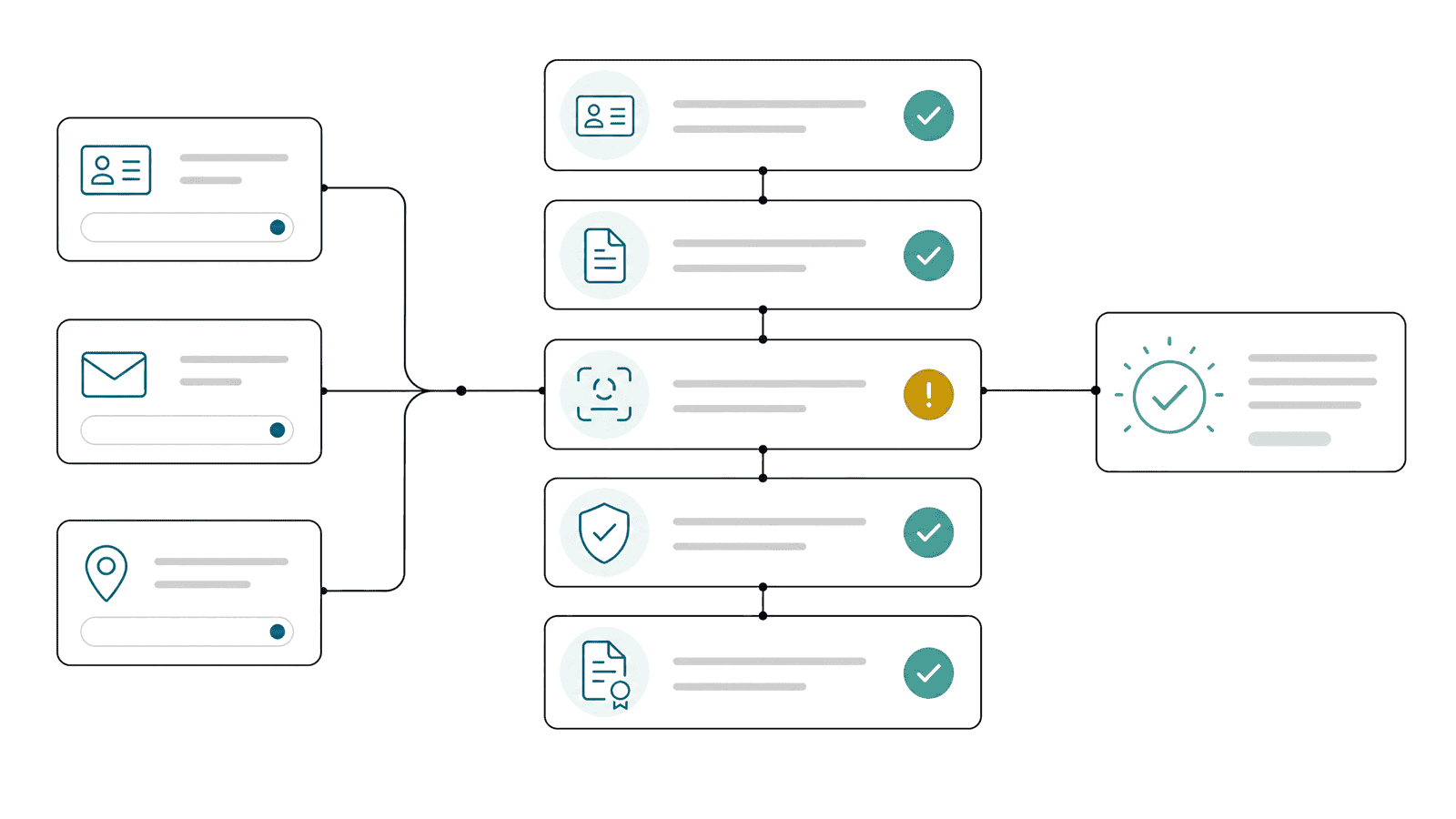
Where the exceptions go.
No register date. A non-standard entity. A company that exists in a form the template did not anticipate. A director who is a company. These are not rare; they are most of what an operations team actually spends its day on.
Poros has a fallback for each rather than a failure. Missing register field, ask for the one document that supplies it. Unusual entity, route it to a template that expects one. What cannot be resolved goes to a person with the case assembled, not to a person with an inbox.
The number to ask a vendor about is not the automation rate. It is what happens to the remainder.
What you get.
Structured results
Your systems act on with no human involved.
Everything else
The structure, the sources, the timestamps, what changed, and a dossier that can go to a regulator without anyone building it first.
A claim with a shelf life
Register changes, sanctions, adverse media, on the company and on the people behind it.
Instant, high-quality translation.
Authoritative documents and register data are translated instantly and at high quality from the native register language, so the original evidence can stay authoritative without becoming an analyst's translation task.
MCC classification is included. Poros asks, in the merchant's own language, what the business actually does, and uses the answer to support the merchant-category decision, without making classification the headline capability.
Why this and not a workflow tool.
Most merchant onboarding platforms coordinate work. This one removes it.
The difference shows in where the data comes from. Coordinating a process still means someone reads a document. Retrieving directly from the register, timestamped, means the document was never in the flow, and neither was the person reading it.
How it fits.
Poros is a complete origination product with its own API and its own back office. Build the journey yourself against the API, or use the interface as it comes.
Inside the platform it shares case context with identity, signing and monitoring, which is what makes the merchant, the directors and the contract one case instead of three.
Runs inside the platform. Works without it.
From application to a decision with one audit trail.
Bring the last ten merchants you onboarded. We will tell you which ones this would have cleared without a human, and which ones it would have stopped.
Not ready to bring the file? See what manual review of those ten is already costing you, from your own numbers.